
The Kids are Alright
If you don’t know what “6-7” means, you probably don’t know many kids. It doesn’t mean anything, and that is the point. Its power lies not in semantic content but in the collective smirk produced when an out-of-touch and grumpty adult tries to decode it. It’s a secret handshake for kids. A punchline without a setup. Pure absurdist memetics, atomized for the middle-school cafeteria.
Naturally, teachers hate it.
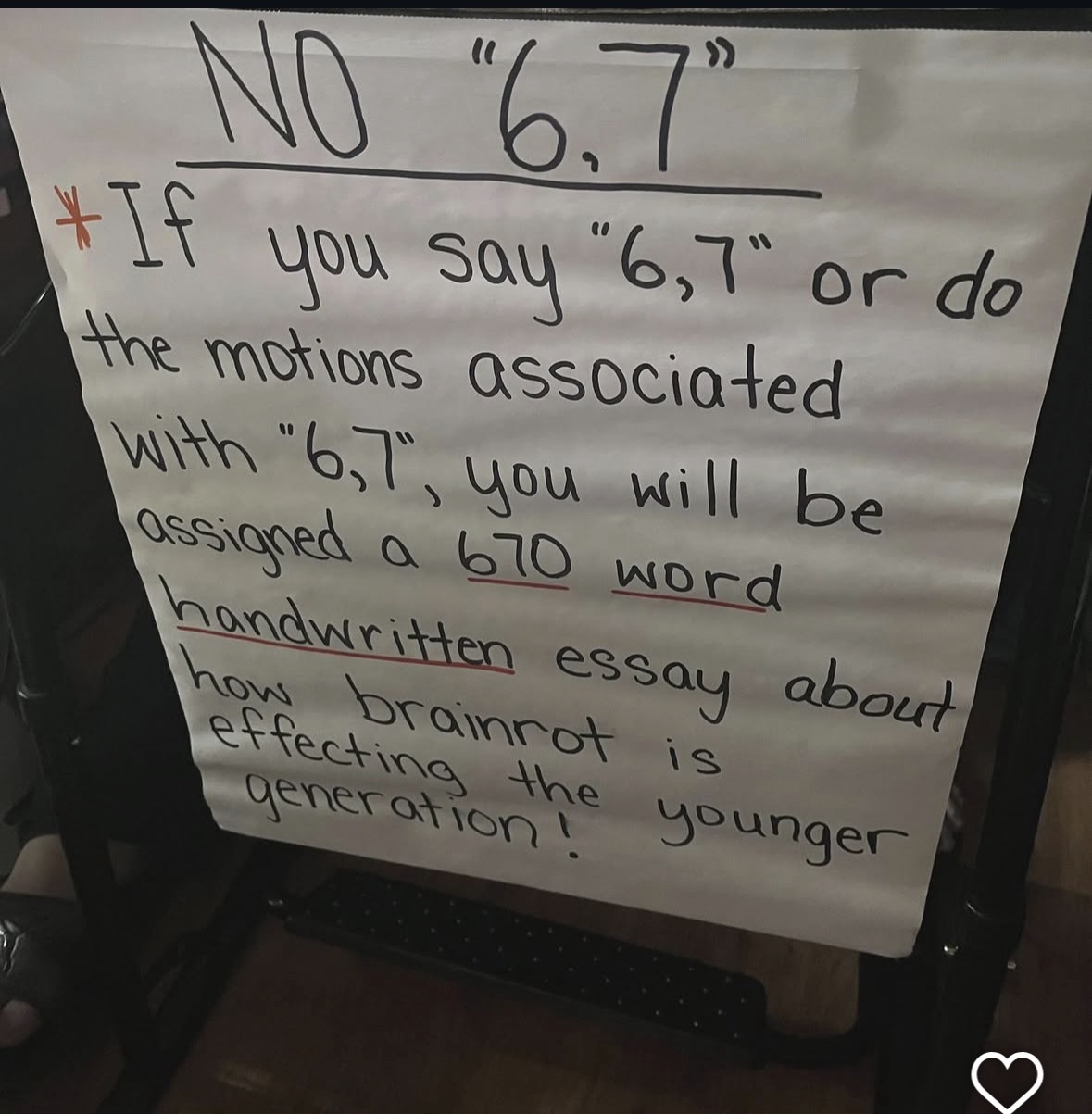
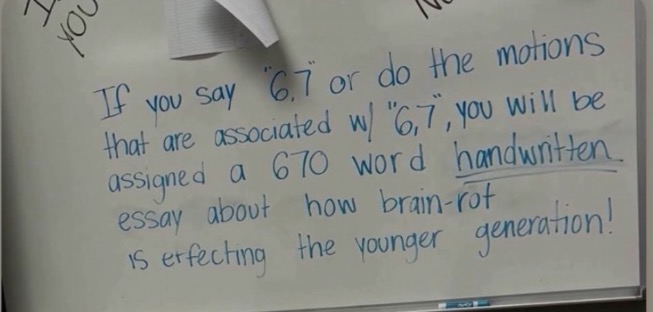
In classrooms from Ohio to Queensland, educators are creating disciplinary policies for students who utter the phrase or perform its accompanying hand motion. Some have instituted escalating consequences. Say “6-7” once and you write a short reflection. Say it again and the reflection balloons to 67 words. Get caught repeatedly and you’re staring down a 670-word essay on how viral culture is “rotting young minds.”
The adults, in other words, are sending kids to detention for participating in a joke — by participating in a joke themselves.
This is my favorite part: while teachers may believe they are fighting youth “brainrot,” they are inadvertently acting out their own version of it. They saw another school do the “67-word essay,” or a TikTok clip of a teacher brandishing the rule, and simply adopted the trend. Viral discipline to stop viral slang. The snake doesn’t just eat its own tail; it drafts a five-paragraph essay about why the tail-eating is unacceptable.
This is not to dismiss the genuine challenges educators face in corralling digital-first students into analog attention. Classrooms are louder, more wired, and more socially performative than ever. But what’s happening here is not pedagogy so much as moral-panic improv — reactive discipline masquerading as intellectual intervention.
For decades, adults have insisted each generation’s slang heralds the collapse of civilization. Jazz-age hepcats, Valley Girl “likes,” the AIM-era “lol.” Every period has treated youth vocabulary like a contagion. The difference now is that the accusation — “brainrot” — inadvertently describes the accusers as well. The teachers policing “6-7” are themselves products of a digital culture that rewards rapid mimicry, performative participation, and reactive, surface-level engagement.
They are essentially saying: Stop repeating viral nonsense by doing exactly what I saw another teacher do on TikTok.
And the kids, being kids, immediately recognize the inconsistency and lean into it. They don’t shout “6-7” because they’ve forgotten how to think. They shout it because it forces adults to think — to confront the anxiety that young people are fluent in a language they don’t control. In that sense, “6-7” is less cognitive rot than cognitive rebellion. A quiet refusal to allow the adult world’s frameworks to govern the emotional temperature of childhood.
Ironically, the phrase “brainrot” may itself be suffering from semantic decay. It once described the genuine effects of overstimulation and algorithmic saturation. Now it’s a catch-all dismissal for anything adults don’t understand — a quick linguistic Band-Aid that saves them from having to actually interact with children. But when all youth behavior is automatically diagnosed as pathological, the diagnosis loses meaning. Worse: it reveals adults have lost patience, nuance, and curiosity — hallmarks, ironically, of cognitive decline.
The real question isn’t whether children have brainrot. It’s whether the over-stimulated grown-ups have lost the ability to distinguish cultural play from cultural decay. To notice that sometimes nonsense is not nihilism, but bonding. Chaos is not always collapse, but a sign of life.
All subcultures use language to assert identity. All generations invent symbols that irritate those prior. The difference is that previous generations didn’t face a chorus of adults ready to draft emotional op-eds, record outraged TikToks, and assign multi-page essays over two numbers uttered during algebra review. That’s not discipline; that’s anxiety with power.
So if you hear a twelve-year-old mutter “6-7” under their breath in homeroom, don’t panic. They are not dissolving into slurry. They are simply signaling to each other that they are young, aware, and alive in their moment. The more we try to smother that instinct under moral-panic homework assignments, the more we reveal the uncomfortable truth:
The kids aren’t rotting.
The adults are decaying in real time.
Word Count: 670